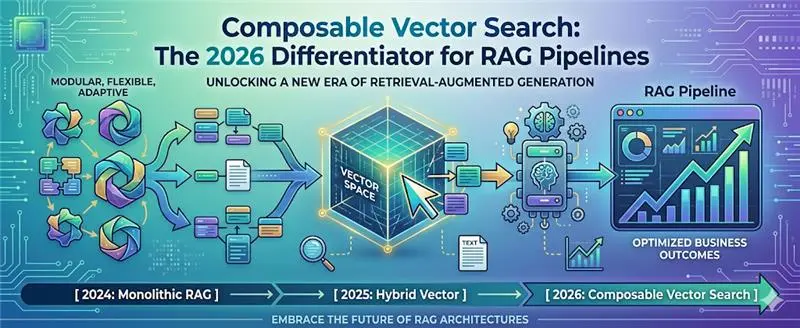
As Retrieval-Augmented Generation (RAG) becomes the backbone of modern AI applications, one thing is clear: basic vector search is no longer enough. In 2026, the real competitive edge lies in composable vector search, a flexible, modular approach that transforms how data is retrieved, ranked, and delivered to AI models.
What is Composable Vector Search?
Composable vector search is an architecture where multiple retrieval strategies, data sources, and ranking mechanisms are combined dynamically to deliver more accurate and context-aware results. Instead of relying on a single vector database or embedding model, composable systems allow you to mix and match components, including keyword search, semantic search, filters, and re-ranking models into a unified retrieval pipeline.
Why Traditional Vector Search Falls Short
Most early RAG implementations rely on simple similarity search. While effective at a basic level, this approach has limitations:
- Low Precision: Results may be semantically similar but contextually irrelevant
- Lack of Control: Limited ability to apply filters or business logic
- Static Pipelines: Hardcoded retrieval flows that don’t adapt to different queries
- Poor Handling of Complex Queries: Struggles with multi-step or domain-specific requests
These gaps directly impact the quality of AI-generated responses.
How Composable Vector Search Changes the Game
1. Hybrid Retrieval for Better Accuracy
Combine vector search + keyword (BM25) + metadata filtering in a single pipeline.
Impact: More precise and relevant results by balancing semantic meaning with exact matches.
2. Dynamic Query Routing
Different queries require different retrieval strategies. Composable systems can route queries based on intent.
Impact: Improved performance for diverse workloads from simple lookups to complex reasoning tasks.
3. Multi-Stage Re-Ranking
Initial results can be refined using advanced re-ranking models (e.g., cross-encoders or LLM-based ranking).
Impact: Higher-quality outputs with better contextual alignment.
4. Modular Architecture
Each component embeddings, vector stores, and ranking models, can be independently upgraded or replaced.
Impact: Future-proof systems that evolve without full redesign.
5. Context Enrichment
Composable pipelines can pull data from multiple sources (databases, APIs, documents) and merge them into an enriched context.
Impact: More informative and accurate AI responses.
Role in RAG Pipelines
In a RAG system, retrieval quality directly determines output quality. Composable vector search enhances every stage:
- Query Understanding: Interpret user intent more effectively
- Retrieval: Combine multiple methods to fetch the best data
- Ranking: Prioritise the most relevant results
- Context Assembly: Deliver richer inputs to the language model
Result: More accurate, reliable, and context-aware AI responses.
Real-World Use Cases
- Enterprise Knowledge Assistants: Retrieve precise internal documentation
- Customer Support Automation: Deliver accurate, context-aware responses
- E-commerce Search: Combine semantic understanding with product filters
- Legal & Healthcare Systems: Ensure high precision with compliance-aware retrieval
Benefits for Businesses
- Higher Answer Accuracy: Better retrieval leads to better AI outputs
- Flexibility at Scale: Adapt pipelines for different use cases
- Reduced Hallucinations: More relevant context reduces incorrect responses
- Faster Innovation: Swap components without rebuilding systems
Challenges to Consider
- System Complexity: More components require better orchestration
- Latency Management: Multi-stage pipelines can increase response time if not optimised
- Data Consistency: Managing multiple sources requires strong governance
However, with the right architecture, these challenges can be effectively managed.
The Future of Composable Search
By 2026 and beyond, composable vector search will become the standard for advanced AI systems. We can expect:
- Deeper integration with agentic AI workflows
- Real-time adaptive retrieval pipelines
- Tighter coupling with multi-modal data (text, image, video)
- Increased use of LLMs for ranking and query planning
Final Thoughts
RAG pipelines are only as powerful as their retrieval layer. Composable vector search takes retrieval from a static function to a dynamic, intelligent system capable of adapting, optimising, and delivering superior results.
For organisations building AI-driven applications, adopting composable search is no longer a nice-to-have; it’s the key differentiator that defines performance, accuracy, and scalability in 2026.