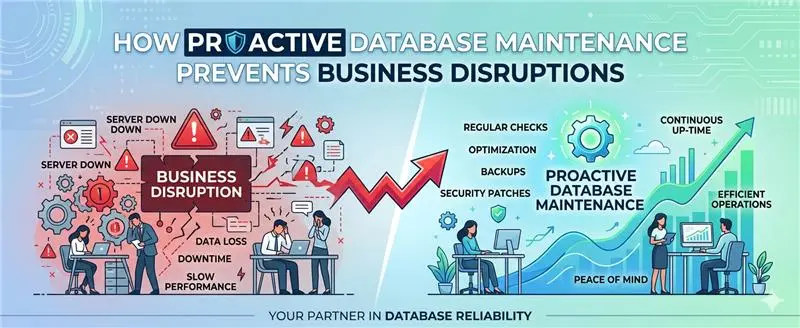
Most businesses only think about their database when something goes wrong. By then, the damage is already done. There’s a particular kind of panic that sets in when a business-critical system goes down mid-morning on a Tuesday. Not a dramatic crash, just a sluggish application, a frozen report, a queue of frustrated staff wondering why nothing’s loading. Then the calls start. Then the scrambling. Then the realisation that whatever’s broken has probably been quietly breaking for days. This is what reactive IT looks like in practice. And for businesses that depend on data, which, in 2025, is essentially every business, it’s an increasingly costly way to operate.
The Difference Between Fixing Problems and Preventing Them
Reactive maintenance is straightforward: something breaks, someone fixes it. It’s familiar, it’s intuitive, and it’s quietly expensive. Proactive database maintenance works differently. Rather than waiting for failure, it continuously monitors system health, performance trends, and early warning signals, addressing issues before they become incidents, and incidents before they become crises. The distinction sounds simple. The operational difference is enormous.
What Proactive Maintenance Actually Involves
Proactive database maintenance isn’t a single action; it’s an ongoing discipline built around several interconnected practices.
Performance Monitoring and Optimisation
Databases degrade over time. Queries that ran efficiently six months ago may now be dragging because of increased data volume, schema changes, or shifts in usage patterns. Proactive maintenance identifies these inefficiencies early, optimising queries, rebuilding fragmented indexes, and ensuring execution plans remain sensible before users notice anything amiss.
Capacity Planning
Storage doesn’t run out overnight. It runs out gradually, with plenty of warning if you’re paying attention. Proactive maintenance tracks growth trends and flags capacity concerns well in advance, giving businesses time to plan rather than scramble.
Backup Verification
Backups are only useful if they work. A surprising number of organisations discover their backup process has been silently failing precisely when they need it most, during a recovery. Proactive maintenance validates backups regularly, ensuring that if the worst does happen, recovery is actually possible.
Security and Compliance Hygiene
Unpatched systems, dormant accounts, and misconfigured permissions are the kind of vulnerabilities that go unnoticed for months until they’re exploited. Regular maintenance includes reviewing access controls, applying patches, and ensuring databases remain compliant with relevant regulations, including UK GDPR.
Routine Health Checks
Error logs accumulate quietly. Disk latency climbs gradually. Certain jobs fail without raising an immediate alarm. Scheduled health checks bring these issues to the surface before they compound into something more serious.
The Real Cost of Doing Nothing
The temptation to leave a functioning database alone is understandable. If it’s working, why interfere?
The answer is that “working” and “healthy” are not the same thing. A database can be functioning whilst simultaneously accumulating the conditions for future failure. By the time those conditions manifest visibly, the cost of resolution in downtime, recovery time, lost data, and staff hours is invariably higher than proactive intervention would have been.
Consider what an unplanned outage actually costs a UK business:
- Operational disruption: staff unable to work, processes halted, productivity lost
- Customer impact: missed SLAs, frustrated clients, damaged relationships
- In competitive markets, reliability is a differentiator
- Recovery costs emergency support, extended engineer time, and potential data loss
- Regulatory exposure, depending on the sector, prolonged data unavailability may carry compliance implications
None of these costs appears on a maintenance budget. They appear later, larger, and at the worst possible time.
Why the “It’s Fine” Assumption Is So Dangerous
Database problems are patient. They don’t announce themselves; they accumulate.
A slow query that adds half a second to a transaction. An index that hasn’t been rebuilt in eighteen months. A log file that’s been growing unchecked. Individually, these are minor. Collectively, they’re the architecture of a future outage.
The businesses most exposed to database failure are rarely the ones that ignored warnings. They’re the ones who never had visibility into those warnings in the first place.
Proactive Maintenance as Competitive Advantage
There’s a commercial argument here that goes beyond risk avoidance. Businesses with well-maintained databases run faster, more reliably, and at lower operational cost. Applications are more responsive. Staff work without friction. Customer-facing systems perform consistently. And when something unusual does occur, it’s detected and resolved quickly rather than discovered mid-crisis.
In sectors where reliability is expected rather than celebrated, such as financial services, healthcare, professional services, and retail, the ability to say “we don’t have outages” is not a technical footnote. It’s a business differentiator.
The Human Element: Why Tooling Alone Isn’t Sufficient
Modern monitoring tools are genuinely impressive. They surface alerts, track metrics, and flag anomalies with increasing sophistication. But they don’t make decisions. They don’t distinguish between an alert that needs immediate action and one that can wait until morning. They don’t have the platform-specific knowledge to know what a query execution plan should look like on a particular version of SQL Server, or how a PostgreSQL configuration should be tuned for a specific workload.
That judgment requires experienced professionals. The combination of intelligent tooling and expert human oversight is what makes proactive maintenance genuinely effective as opposed to merely well-instrumented.
Getting Started: What to Review First
If your organisation hasn’t conducted a formal database health review recently, a reasonable starting point includes:
- Backup integrity: When were your backups last tested? Not run tested.
- Query performance regarding long-running queries that have never been reviewed?
- Index health fragmentation levels and whether existing indexes remain appropriate
- Access controls, who currently have access to what, and is that still correct?
- Patch status: Are your database platforms running current, supported versions?
- Capacity trends at current growth rates, when will you face storage constraints?
These aren’t complex questions. But the answers often reveal more than expected.
The Bottom Line
Proactive database maintenance isn’t a premium option for large enterprises. It’s the standard practice for any business that relies on data to operate, which, in the current environment, is virtually all of them.
The choice isn’t really between proactive and reactive maintenance. It’s between planned, managed costs and unpredictable, disruptive ones. Waiting for something to break before you fix it is a strategy. It’s just not a particularly good one.