For UK organisations, databases underpin everything from customer experience to compliance reporting. Yet when it comes to managing them, many businesses face a critical decision: build an in-house DBA function, or partner with a managed database support provider.
On paper, hiring internally offers control. In practice, the comparison across cost, operational risk, and performance often tells a different story. This article examines both models clearly, so you can make the decision that is right for your business.
The Two Approaches, Clearly Defined
In-House DBA
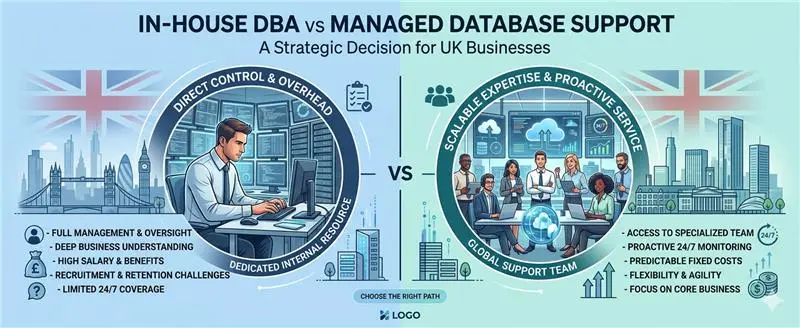
An internal Database Administrator or team responsible for day-to-day management, performance, security, and troubleshooting, fully embedded within your organisation. This model offers familiarity with internal systems and direct alignment with business culture. However, it also places significant responsibility on a small number of individuals.
Managed Database Support
An external partner delivering 24/7 monitoring, maintenance, optimisation, and security, typically under a service level agreement (SLA), with access to a broader team of specialists. Rather than relying on one or two individuals, you leverage a dedicated team whose sole focus is database performance and reliability.
Cost: Visible Salaries vs Total Cost of Ownership
At first glance, an in-house DBA appears straightforward: hire a skilled professional, and you are covered. However, UK businesses often underestimate the true cost of ownership. Salaries alone range from £50,000 to £90,000 or more, but that figure is only the beginning.
The Real Cost of In-House
When you account for the full picture, the expense grows considerably: employer costs including National Insurance contributions, pensions, and benefits; recruitment and onboarding expenses; ongoing training and professional certifications; tooling, licences, and infrastructure overhead; coverage gaps during leave, sickness, or out-of-hours incidents; and the reality that one DBA rarely provides adequate coverage meaning additional hires or operational compromise.
The Managed Support Model
A managed service restructures costs entirely: fixed, predictable monthly fees with no hidden overhead; no recruitment, HR, or onboarding burden; enterprise-grade monitoring tools included as standard; a full team of specialists available for the equivalent cost of a single hire; and round-the-clock support built into the service.
In a market where technical talent is both expensive and highly competitive, managed services frequently deliver stronger value per pound spent without sacrificing capability.
Risk: Key Person Dependency vs Operational Resilience
One of the most overlooked risks in database management is organisational fragility. When your entire database function rests on one or two individuals, the consequences of disruption can be severe.
The In-House Risk Profile
The vulnerabilities are significant: a single point of failure if a key DBA resigns or is unavailable; limited or no out-of-hours coverage for critical incidents; knowledge siloed within individuals rather than documented and shared; and slower incident response when problems arise at inconvenient times. Even the most capable DBA cannot be everywhere at once. Holidays, illness, and resignation are all inevitable, and any of them can expose your systems at the worst possible moment.
The Managed Support Advantage
Managed providers are structured to eliminate these vulnerabilities. Team-based delivery means no single departure compromises your operations. Round-the-clock monitoring ensures problems are identified and addressed before they escalate. Defined SLAs create accountability for both response time and resolution, while established processes reduce the risk of human error.
Managed support transforms database management from a person-dependent function into a resilient, documented service.
Performance: Reactive Support vs Continuous Optimisation
The way database management is structured fundamentally shapes how performance is handled and whether problems are caught before or after they affect your business.
In-House Constraints
Internal teams are frequently stretched across multiple competing priorities: managing helpdesk tickets, supporting development teams, and responding to ad hoc requests. This environment tends to produce a reactive operating model, where issues are addressed after they surface rather than anticipated in advance. When a DBA is pulled in multiple directions, proactive optimisation of the work that prevents problems is the first thing to be deprioritised.
The Managed Service Approach
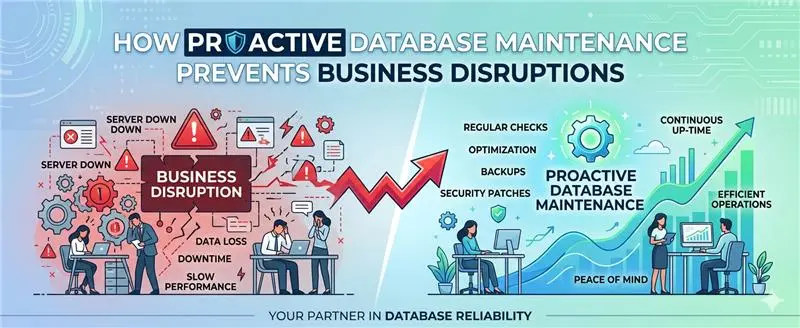
Managed providers are structured specifically for proactive performance management: continuous monitoring of database health and availability; query tuning and index optimisation as an ongoing discipline; capacity planning and forecasting to stay ahead of growth; and regular performance reporting for full visibility and accountability.
In competitive sectors, database performance directly affects revenue, customer satisfaction, and brand reputation. The organisations that treat performance as a proactive discipline consistently outperform those that treat it as an afterthought.
Compliance & Security: Keeping Pace with UK Standards
With regulations including UK GDPR, ISO 27001, and PCI-DSS, database governance is non-negotiable. The cost of non-compliance, financial, reputational, and operational, far exceeds the cost of getting it right.
Internal teams often struggle to maintain a consistent compliance posture: keeping up with evolving regulatory requirements, ensuring audit readiness at all times, and managing patching and vulnerability remediation promptly. Specialist providers, by contrast, embed compliance as a core part of their service with built-in frameworks aligned to UK and international standards, regular audits and documentation, proactive patching, and cross-industry expertise drawn from working across multiple regulated environments.
The result is a stronger, more consistent compliance posture delivered without placing additional burden on your internal teams.
Scalability: Growing Without Delays
Business growth rarely follows a predictable timeline, and neither do the demands placed on your database infrastructure. Scaling an internal function takes time, additional capacity requires budget approval, recruitment cycles, and onboarding, all of which introduce delays that can last months. During periods of rapid growth or peak demand, those delays are rarely affordable.
Managed support is designed to flex with your business. Services can be scaled up or down without hiring processes, new capacity can support growth immediately, and peak demand is handled without disruption or compromise. In practice, managed support aligns far more naturally with the pace at which modern UK businesses need to operate.
Expertise: Individual Knowledge vs Collective Intelligence
An in-house DBA brings valuable experience, often deep familiarity with your specific systems and culture. But that knowledge is necessarily limited by one person’s professional background. Managed providers offer a different kind of depth: multi-platform expertise spanning SQL Server, Oracle, PostgreSQL, and cloud-native environments; exposure to diverse architectures and complex operational challenges; and a collective knowledge base drawn from a team of specialists, not a single individual. This breadth typically translates into faster resolution times, more effective optimisation, and the ability to anticipate challenges your internal team may not have encountered before.
When Each Model Makes Sense
There are circumstances where building or retaining an internal DBA function is entirely appropriate, particularly for organisations with highly specialised or legacy systems requiring deep institutional knowledge, strict data control environments where external access is restricted, or large enterprises with mature, established 24/7 IT functions already in place.
For many UK organisations and particularly for SMEs and scaling businesses, managed support offers clear, measurable advantages: genuine 24/7 monitoring and incident response, reduced operational costs without compromised capability, minimised risk and key person dependency, and a proactive approach to performance and regulatory compliance.
The Bottom Line
This is not simply a choice between internal and external resources. It is a decision about how your business approaches reliability, cost control, and risk and what standard you hold your database infrastructure to.
In-house DBAs offer a sense of control, but frequently come with hidden costs, resilience gaps, and operational constraints. Managed support delivers resilience, scalability, specialist expertise, and proactive performance as a structured service.
In an environment where downtime affects both revenue and reputation, the organisations reaching a clear conclusion are those that have stopped asking who manages their database and started asking whether it is always performing, always secure, and never a point of failure.