Introduction
As UK enterprises modernise legacy systems and move towards distributed, cloud-native architectures across platforms such as AWS and Microsoft Azure, one of the most critical design decisions remains the choice between SQL (relational databases) and NoSQL (non-relational databases).
This is no longer a simple database preference. It is an architectural decision that directly affects data consistency models, system scalability, latency behaviour, and operational resilience.
In large-scale environments, particularly those supporting high transaction volumes or real-time data processing, both SQL and NoSQL often coexist as part of a broader data architecture strategy.
SQL and NoSQL in an Enterprise Architecture Context
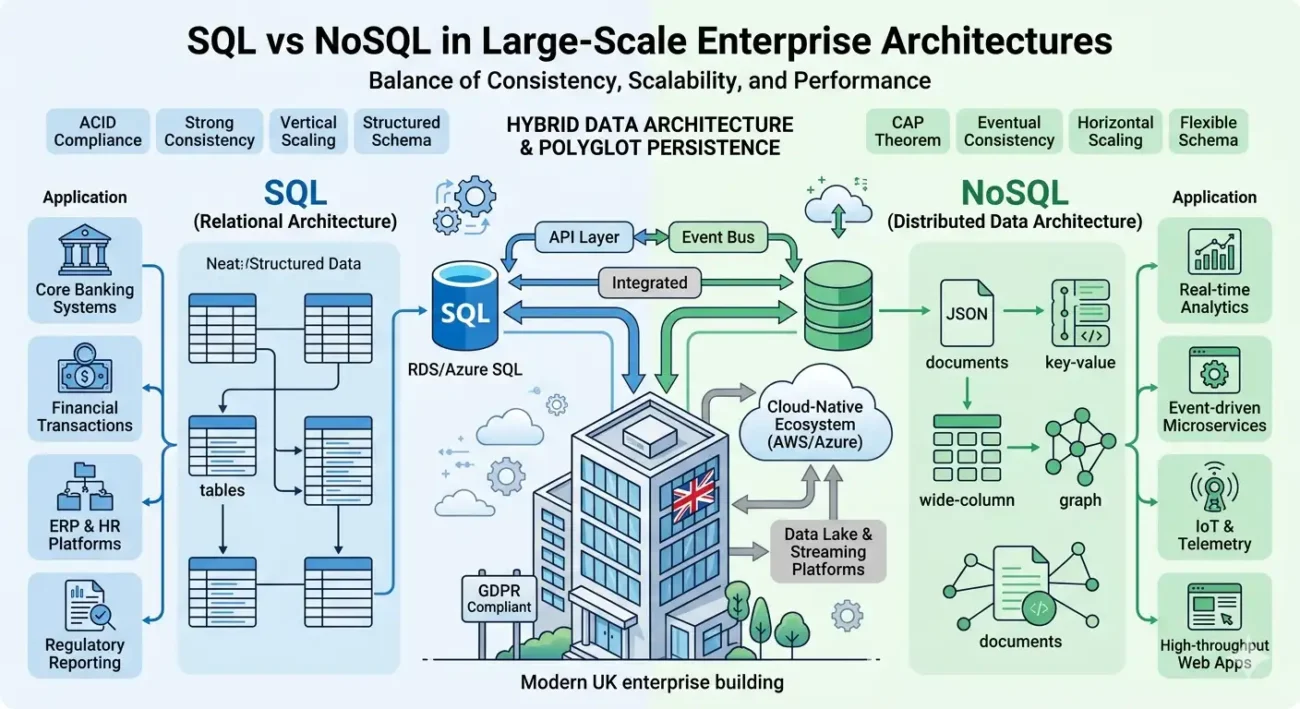
SQL (Relational Architecture)
SQL databases are built around structured relational models where data is stored in predefined schemas and relationships are enforced through constraints and keys.
From an enterprise architecture perspective, SQL systems typically operate within strong consistency models (ACID compliance), making them suitable for systems where transactional integrity is critical.
These are commonly deployed in:
- Core banking systems
- Financial transaction processing
- ERP and HR platforms
- Regulatory and audit reporting systems
They are typically deployed on vertically scaled infrastructure or managed relational services such as Amazon RDS or Azure SQL Database.
NoSQL (Distributed Data Architecture)
NoSQL databases are designed for distributed, horizontally scalable architectures, often optimised for high availability and partition tolerance under the CAP theorem.
Instead of rigid schemas, NoSQL systems support flexible data models such as:
- Document-based storage (e.g. JSON structures)
- Key-value stores
- Wide-column databases
- Graph-based data models
These are commonly deployed in:
- Real-time analytics platforms
- Event-driven microservices architectures
- IoT and telemetry systems
- High-throughput web applications
They are widely used in cloud-native environments where workloads are distributed across multiple nodes and regions.
Architectural Differences at Scale
1. Data Modelling and Schema Enforcement
SQL enforces strict schema definitions at the database level, which ensures consistency but introduces rigidity during schema evolution.
NoSQL systems allow schema flexibility, enabling rapid iteration in distributed application environments where data structures evolve frequently.
2. Scaling Strategy
SQL databases typically follow a vertical scaling model, where performance is improved by increasing compute resources on a single node or cluster.
This model becomes limited under high concurrency or large dataset volumes.
NoSQL systems are designed for horizontal scaling, distributing data across multiple nodes or shards. This supports elastic scaling patterns common in cloud-native architectures.
3. Consistency Models
SQL systems enforce strong consistency, ensuring all transactions are immediately reflected across the database.
NoSQL systems often operate under eventual consistency models, optimising for availability and partition tolerance in distributed systems.
This trade-off is central to architectural design in large-scale systems.
4. Querying and Data Access Patterns
SQL supports complex relational queries, joins, and transactional integrity across multiple tables, making it suitable for structured analytical and operational reporting workloads.
NoSQL systems optimise for direct access patterns, often denormalising data to reduce query complexity and improve latency in distributed environments.
Enterprise Use Cases in Modern UK Systems
SQL is typically aligned with:
- Financial transaction systems requiring ACID guarantees
- Regulatory and compliance-driven reporting systems (e.g. GDPR-aligned data storage)
- Enterprise resource planning (ERP) platforms
- Master data management (MDM) systems
These systems prioritise data integrity, auditability, and transactional reliability.
NoSQL is typically aligned with:
- Event-driven microservices architectures
- Real-time streaming and telemetry pipelines
- High-scale web platforms and APIs
- Personalisation engines and recommendation systems
- IoT and sensor data ingestion systems
These workloads prioritise low latency, scalability, and distributed processing efficiency.
Hybrid Data Architecture in Modern Enterprises
In most large-scale UK enterprise environments, the architecture is no longer binary.
Instead, organisations implement polyglot persistence models, where multiple database technologies are used within the same ecosystem.
A typical architecture may include:
- SQL databases for transactional and operational systems
- NoSQL databases for event processing and high-volume workloads
- Data lakes and streaming platforms for analytics integration
- API layers and event buses to connect distributed systems
This allows enterprises to balance consistency, scalability, and performance across different system layers.
Architectural Considerations for Decision-Making
When selecting between SQL and NoSQL in enterprise environments, architects typically evaluate:
- Data consistency requirements (strong vs eventual consistency)
- Workload type (transactional vs event-driven)
- Expected throughput and latency requirements
- Cloud-native scalability requirements
- Integration complexity across distributed systems
- Regulatory and compliance constraints
The decision is fundamentally architectural rather than purely technological.
Conclusion:
SQL and NoSQL are not competing database technologies—they represent different architectural paradigms within modern enterprise system design.
SQL remains essential for structured, transactional workloads where consistency and reliability are non-negotiable.
NoSQL enables scalable, distributed architectures required for modern cloud-native applications and high-volume data systems.
In practice, the most effective enterprise architectures are those that adopt a hybrid data strategy, using each technology where it is most appropriate rather than forcing a single model across the entire ecosystem.